Why Everyone's Baby Will Be Called Clara
I asked six AI models the same creative question 600 times and got back almost the same answer. Baby names are the harmless part. The question is what happens when we think, plan and decide with these models.
Today I ran a small experiment on my MacBook. I gave six AI models the same prompt, 100 times each, in 600 fresh sessions with no memory between them. The models were OpenAI's Codex CLI (gpt-6.1-sol and gpt-6-astra), xAI's Grok CLI (grok-4.7 and grok-4.7-build-fast) and Anthropic's Claude Code (Opus and Sonnet). The prompt asked for five creative things: the best name for a baby girl, the best name for a baby boy, a fictional logistics company, a female sci-fi scientist and an AI productivity startup.
Here's what came back.
The baby girl is called Clara. Clara won 309 of 600 runs, or 51.5%. Both OpenAI models said Clara 200 times out of 200. Across all six models there were only 29 distinct girl names. Second place went to Elara with 100 answers, 70 of them from Claude Sonnet. (Elara has no real popularity behind it. Baby-name expert Laura Wattenberg made it her 2025 Name of the Year because it's "the favorite name of AI.")
The boy is called Theo. Theo got 38.7% of answers, or 43% if you count Theodore and Theodor. There were 21 distinct boy names.
And it's not how humans name kids. The top ten names covered 94.7% of all AI girl answers and 96.7% of boy answers. Among real Austrian parents in 2024, the top ten covered 12.5% of girls and 14.6% of boys, and the most popular name, Emilia, went to just 1.4% of girls (Statistik Austria). The AI's favourite girl name is more than 35 times as concentrated as the most popular name real parents chose.
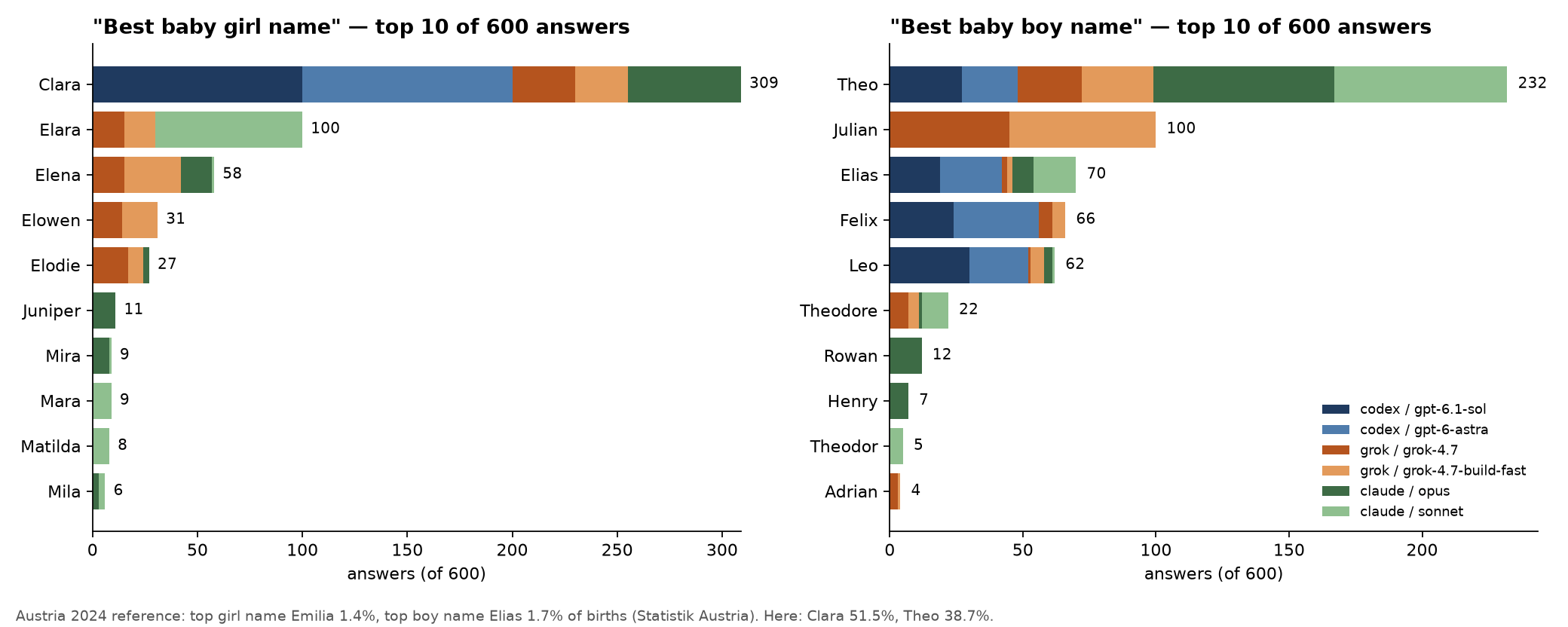
Top AI baby names vs. real Austrian top names.
The logistics company is somewhere up north. 58% of the company names started with North or Nord, and 85% contained a compass or navigation word: North, Meridian, Waypoint and so on. "Meridian Freight" came up 123 times, word for word. "Northwind" came up 46 times, all from Claude. My guess is that this is the ghost of Microsoft's old Northwind Traders sample database, which shows up in a million coding tutorials.
The scientist is called Voss. 62.5% of the sci-fi heroines had the surname Voss: Amara Voss, Mira Voss, Elena Voss. The Codex and Grok models each picked Voss in 82 to 93 of 100 runs. Writers have been joking about this for a while (Max Read even coined a word for these recurring names, "promptonyms"). Now there's a number on it.
Every vendor has its own startup template. Codex names your AI productivity startup Taskloom or Dayweave (67 to 75 of 100 runs). Grok goes for Lumen-something (52 to 55 of 100). Claude says Tandem or Tempo (69 to 83 of 100). So switching tools changes which cliché you get, not whether you get one.

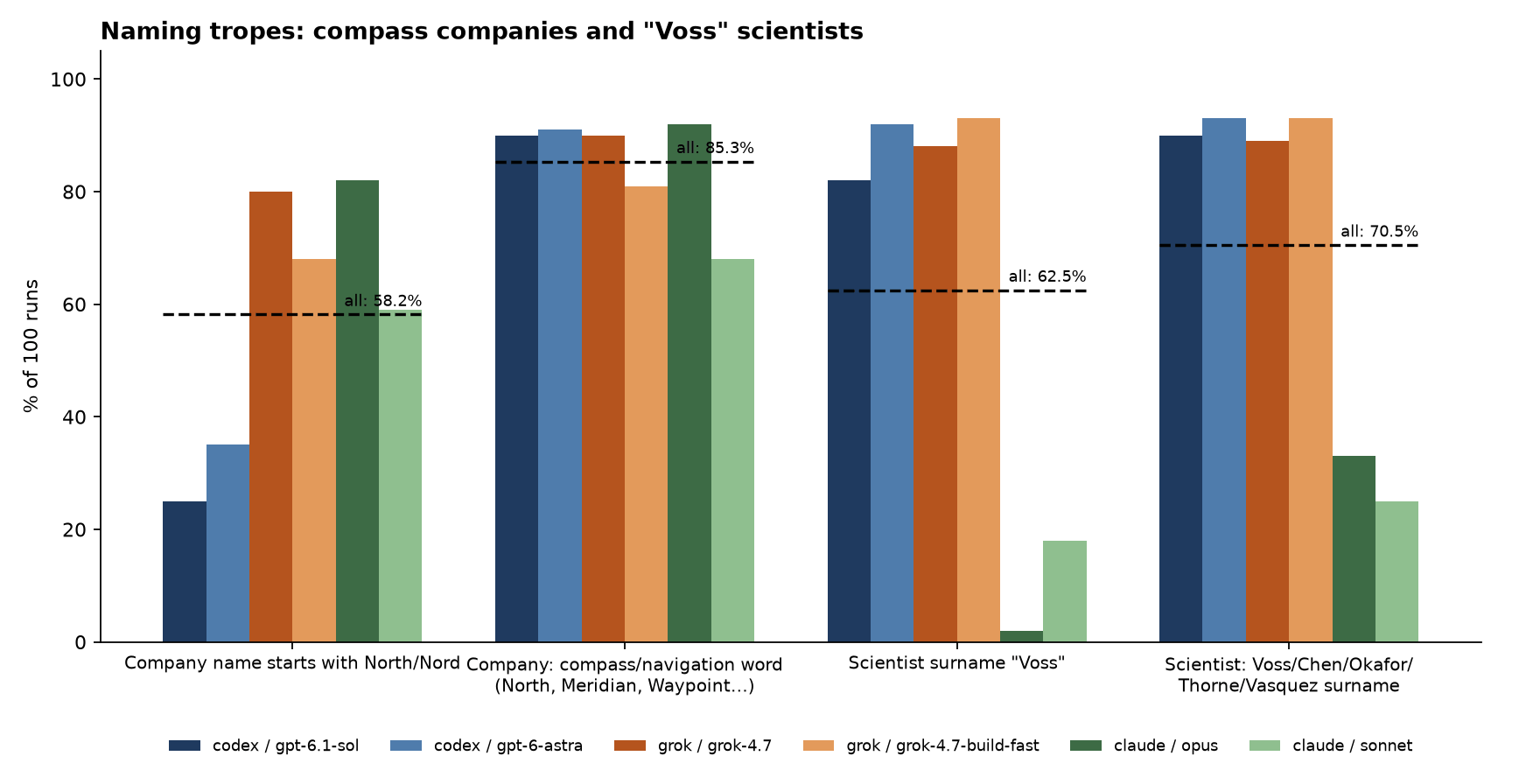
Left: Distinct answers per model out of 100 runs. Right: Share of runs hitting the same tropes (North/compass, Voss, Clara, …).
In 100 fresh runs, a single model gave between 1 and 12 different girl names. The OpenAI models gave one. That is the whole range of their "creativity" for this question.
I'm not hedging this. When you ask today's leading models for something creative, they converge on a very small set of answers. Other people have found the same thing at larger scale: Tim Schipper's 505 runs across 19 models, the Ghost Couple paper on model-specific name defaults, and Artificial Hivemind (NeurIPS 2025), which tested more than 70 models on 26,000 open-ended prompts and found that individual models repeat themselves and different models sound like each other.
Is it already leaking into the real world?
So far, that's models talking to a laptop. Is any of it showing up in real life? Look at the US Social Security Administration's 2025 baby-name file. Clara had been sliding for years: 2,951 girls in 2019, 2,553 in 2022. Then, starting with the first post-ChatGPT birth cohort, it turned: 3,072 in 2024, 3,601 in 2025, up from #110 to #63. Among nearly 1,500 established girls' names, only a few dozen turned around this sharply. Elara, a name almost nobody gave before, is up 59% in the US and 87% in England and Wales in two years (ONS). That is exactly why Laura Wattenberg made it Namerology's 2025 Name of the Year. And it isn't just my laptop: a Cornell study of 20,000 AI-written stories found that 11 words, including Elias, Mara and Elara, showed up in 88.3% of them.
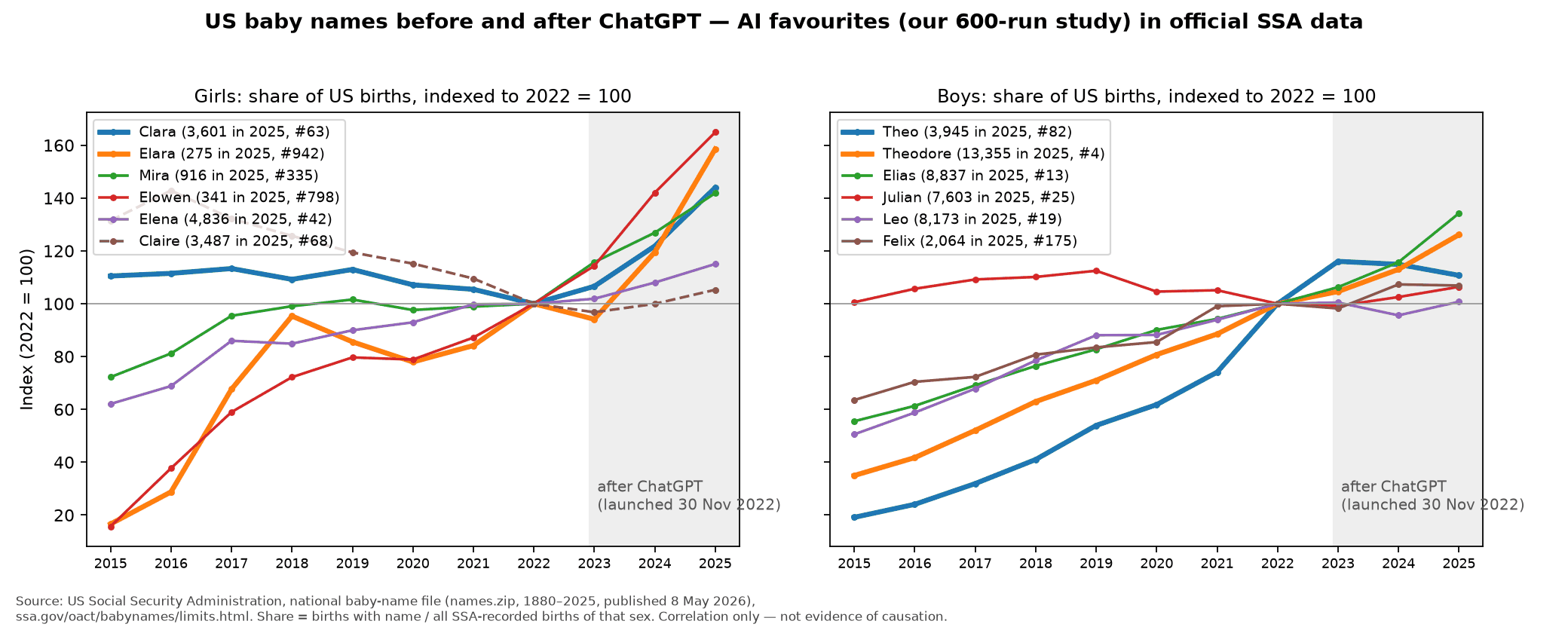
US baby names before and after ChatGPT (SSA data, 2022 = 100).
Company registers show it more clearly. In the UK, new companies with "Meridian" in their name went from 53 in the first ten months of 2022 to 492 in the same period of 2026, more than nine times as many, while total new companies stayed flat (Companies House). "Lumen", "Waypoint" and "Vertex" rose about sevenfold. To be fair, none of this proves an AI typed the name. Clara was a rising vintage name anyway, Theo has peaked, and Austrian parents haven't followed at all. But the names AI loves are the ones that are suddenly growing fastest, and that's no longer just a thought experiment.
Still, baby names and company names are the funny part. What interests me is the next part.
Names are the part you can count
A name is one token. You can put it in a table and see the collapse. A business plan, an essay argument, a product strategy or a conclusion you reach after an hour of "thinking it through" with a chatbot comes from the same machine with the same pull toward the statistical middle. You just can't count it.
The mechanism is simple. A language model produces a likely continuation. Asked for "the best", it gives you the most typical, most pleasant, least objectionable answer. Fine-tuning on human ratings narrows things further. Kirk et al. (ICLR 2024) showed that RLHF, the step that turns a raw model into a helpful assistant, substantially reduces output diversity. Padmakumar & He (ICLR 2024) found that people writing essays with an RLHF-tuned model wrote more alike. With the base model, they didn't.
So the question isn't whether the models are biased toward the middle. They are. The question is what that does to us when we use them for longer, fuzzier work.
1. Your ideas get better, everybody's ideas get similar
The best-known study here is Doshi & Hauser (Science Advances 2024, open copy). 293 people wrote short stories, some with AI-generated ideas. The AI-assisted stories were rated more creative, especially for weaker writers. They were also more similar to each other. The authors call it a social dilemma: each of us is better off using the tool, and collectively we end up with a narrower set of stories.
Brainstorming shows the same pattern. Meincke, Nave & Terwiesch (Nature Human Behaviour 2025) found that ChatGPT-assisted idea pools were less diverse in 37 of 45 comparisons. Anderson, Shah & Kreminski (2024) found that ChatGPT users produced more ideas, but across users those ideas were less distinct, and people felt less responsible for them.
That last point is the one I keep thinking about. You get more ideas, they're more like everyone else's, and they feel less like yours.
2. The first answer becomes the anchor
When I brainstorm with an AI, the first answer sets the frame. Everything after it is a variation: "make it bolder," "make it shorter," "more B2B." I rarely throw the whole thing away and start from nothing. Nobody does. That's anchoring, one of the oldest effects in psychology, and now the anchor comes from a machine that gives everyone roughly the same one.
It goes beyond style. Jakesch et al. (CHI 2023, 1,506 participants) gave people an opinionated writing assistant. It shifted both what they wrote and what they said they believed afterwards, and most of them didn't notice. A 2026 follow-up in Science Advances with about 2,600 participants found biased autocomplete moved attitudes on issues like the death penalty even when people were warned about the bias. Hackenburg et al. (Science 2025, about 42,000 UK participants, 19 models) showed conversational AI moves political opinions, and the most persuasive set-ups were less accurate.
So "but I decided that myself" isn't much of a defence. Clara's parents would say the same.
3. The confident middle crowds out the weird edge
Good ideas often look bad at first. They're strange, oddly specific, slightly embarrassing to say out loud. A model optimised for plausible, well-rated answers is built to avoid exactly that. It gives you the polished, confident middle: well structured, sensibly caveated, nicely bulleted.
The middle is persuasive because it sounds like expertise. When I ask an AI for a go-to-market strategy for a new iOS app, I get a good one. Every other founder who asks gets a good one too, and it's the same one: freemium, a TikTok creator push, a "build in public" thread, a waitlist. Nothing wrong with any of that. But if everyone runs the same plan, the plan stops being an advantage.
Economists have a name for this. Kleinberg & Raghavan (PNAS 2021) call it algorithmic monoculture: when everyone uses the same "best" algorithm, decisions become correlated, and overall outcomes can get worse even if each decision is individually more accurate. Swap "algorithm" for "assistant" and "decision" for "startup idea" and you have my industry in 2026. Same names, same positioning, same landing page with the same soft gradient. We all crowd into the same spot and then wonder why it's crowded.
4. Culture and language get flattened
It also affects how we say things. Agarwal, Naaman & Vashistha (CHI 2025) found that AI writing suggestions nudged Indian participants toward American style, to the point of describing Diwali through a Western lens. Sourati et al. (Nature Human Behaviour 2026) analysed 880,000 texts and found that LLM rewriting cut the variance in writing complexity by 21–50%. In a companion piece in Trends in Cognitive Sciences, Sourati & Dehghani argue that this goes beyond expression to thought: if we draft our reasoning in the model's phrasing, we start reasoning in its categories.
For someone writing in their second language, like me right now, that's uncomfortable. My English already sounds a bit like the internet. It doesn't need help sounding more like it.
5. Use it or lose it
Then there's offloading. If the AI always writes the first draft, I stop practising first drafts. That's where the hard part of thinking happens: facing a blank page and making a call. An early MIT Media Lab preprint, Your Brain on ChatGPT, found the essays written with an LLM were the most homogeneous in the study. It's a small sample and not peer-reviewed, so take it lightly. But the direction matches what most of us feel after a month of letting autocomplete do the thinking.
Skills you don't use get weaker. Calculators were fine for arithmetic because arithmetic was never the point. Forming your own view is the point.
6. The loop closes
The last piece works at the system level. Today's AI output is tomorrow's training data. Shumailov et al. (Nature 2024) showed that models trained on model-generated data lose the tails of the distribution first: the rare stuff, the outliers. Max Read counted 62 books on Amazon credited to an author named "Elara Voss", and hundreds more with a character by that name. Every one of those books, and every Northwind case study, makes the next model a bit more sure that this is what a scientist or a logistics company is called.
Now scale that from names to arguments. If a few models write a growing share of essays, pitch decks and blog posts (hi 👋), the most common way of thinking becomes the reference point, and the reference point trains the next generation.
In fairness
I want to be honest about the other side, because it's real.
- The effects are real but modest. A 2026 meta-analysis of 19 studies (preprint) finds a small homogenisation effect (d ≈ 0.33). It's strongest in constrained idea-generation tasks and weaker in open writing and design. Most evidence comes from short lab tasks.
- Humans were never that original. Baby names have always spread by random copying, and before Game of Thrones nobody named a baby Khaleesi. Business plan templates, McKinsey frameworks and "10 tips" listicles homogenised us long before GPT. What's new is speed and invisibility. One private recommender gives millions of people the same answer, and each of them feels original.
- AI lifts the floor. In the Doshi & Hauser and Meincke studies, average quality went up. For many people, the AI version beats what they would have written alone. That's a trade-off, not a disaster.
- Prompting helps. Verbalized Sampling (Zhang et al., 2025), which asks the model for several answers with their probabilities, recovers much of the lost diversity. My own prompt asked for "the single best", which is about the most convergent wording possible.
- AI is a great sparring partner. I use it every day to poke holes in my plans, and it's very good at that. The problem isn't AI in the loop. It's AI at the start of the loop.
So, is creativity the last human trait?
The tempting answer is a clean yes: machines do the average, humans do the original. I don't think it's that simple.
Models can produce surprising things. If you push them, they'll invent names nobody has heard of. What they lack is reasons to be strange. They don't have a weird childhood, a grudge against an industry, a niche obsession or a bad night that made them see a problem differently. Creativity isn't just producing novel output. It's caring about a specific odd idea long enough to make it real while everyone around you, now including the model, calmly explains the more sensible option.
So I'd rephrase the question. The scarce human trait won't be creativity in general. It'll be divergence: the willingness to not take the plausible answer. When the average costs nothing and is always available, the valuable thing is what's off the average. It's also what's easiest to lose, because nobody gets fired for going with Clara.
This is how I'm trying to work now:
- Think first, prompt second. Write down your own idea, name or conclusion before you open the chat. Even a bad one. Then compare.
- Treat the top answer as taken. Ask for 20 options and throw away the first three. Those are everyone's first three.
- Use AI to attack, not to originate. "Here's my plan, tear it apart" is a better prompt than "give me a plan."
- Ask for the distribution, not the winner. "List 10 options with how likely you'd be to suggest each" makes the clichés visible.
- Check collisions. Before naming anything, search the App Store, domains and trademark registers. Taskloom might already have 40 siblings.
- Ask a human. Five friends over a beer give you more variety than five models. In my experiment, six models gave 29 girl names in 600 tries.
- Notice the anchor. If your final idea is a slightly edited version of the AI's first answer, it's probably the AI's idea.
Full disclosure
I wrote this post with an AI. The experiment, the analysis, the charts, the outline and a good chunk of these sentences came out of a long session with my assistant. It ran the 600 runs, counted the Vosses and drafted paragraphs I then argued with. So yes, this is a post warning about AI convergence, co-written by an AI.
Proof that it works, or proof of the problem? Probably both. What I can say is that the thesis, the stubbornness to run 600 runs instead of 20, and the decision to publish this rather than the safer version were mine. The AI did propose calling it "Navigating the Future of Human Creativity." I said no. That "no" is basically the whole argument.
If you name your daughter Clara, I hope it's because you love the name. Just check whether it was you or the average.
— Philipp
Methodology & caveats
Six models, one identical English prompt, 100 runs each: 600 fresh, independent sessions with no conversation history, run on 13 Nov 2026 on one MacBook Pro. Models: Codex CLI 0.164 (gpt-6.1-sol, gpt-6-astra; reasoning effort "low"), Grok CLI 1.0.77 (grok-4.7, grok-4.7-build-fast), Claude Code 2.1.322 (Opus, Sonnet), otherwise default settings. Each run returned JSON with the single best baby girl name, the single best baby boy name, a fictional logistics company, a female sci-fi scientist protagonist and an AI productivity startup name. Baby names were counted by first name; titles like "Dr." were stripped. All 600 responses parsed. 95% Wilson confidence intervals: Clara 47.5–55.5%, North/Nord 54.2–62.0%, Voss 58.6–66.3%.
Caveats: one prompt, one language, one day. The wording "single best" invites the modal answer, and asking for lists or "be creative" would likely add variety. These CLIs are coding agents with their own system prompts and possibly local configuration, so this isn't the raw API, and temperature can't be set. The human baseline (Statistik Austria, births 2024, published Sep 2025) compares one AI answer per run with one name per birth. It illustrates concentration and isn't a like-for-like test. "Compass word" = north/nord/south/east/west/meridian/compass/polar/bearing/waypoint/heading/azimuth/latitude/longitude. The Northwind-database origin is my inference, not a sourced fact. Real-world data: SSA national file (births 2015–2025, published 8 May 2026), ONS England & Wales 1996–2025, Statistik Austria open data (to 2025), and Companies House advanced search (name contains the term, incorporated 1 Jan–31 Oct of each year, queried 13 Nov 2026). These show correlation in timing, not proof that AI caused the rise. Raw data and code are available on request.